
⏱️ Estimated reading time: 7-9 minutes
Jihad:
The term “Jihad” does not mean “Holy War.” The true origin and meaning of the term “Holy War” will be explained below in the next chapter.
In Arabic, “Holy War” would be “al-harb al-muqaddasah,” but this phrase is nowhere to be found in the Qur’an or the Hadiths (the sayings of Prophet Muhammad).
In the Qur’an, Jihad refers to striving, struggling, and making continuous efforts to follow the right path. The Prophet Muhammad (peace be upon him) said, “The most excellent Jihad is that for the conquest of self.”
Jihad can take many forms:
- Fighting against evil in society (example: corruption) is one form of Jihad.
- Going to work each day to contribute to society is another form of Jihad.
- Working to improve your life and the lives of your children is a form of Jihad.
- Volunteering to assist those in need is another example of what Jihad can encompass.
Resisting Occupation and Self-Defence:
The right of resisting foreign occupation is acknowledged as both a divine right and a legitimate aspect of international law. This is reflected in UN Resolution 3246 (adopted on November 29, 1974), which declares that “all peoples subjected to foreign occupation have the right to resort to armed resistance.”
In Islam it is strictly forbidden for Muslims to be the initiators of war. When a Muslim country is invaded and after having exhausted all forms of diplomacy (diplomacy is also a form of jihad in order to prevent armed conflict and the loss of human lives) and if war is imminent, scholars and people of knowledge will decide if fighting is necessary. If that is the case, defending the country from invaders becomes a form of Jihad.
While defending themselves during a war, Muslims must obey strict rules:
It is forbidden for Muslims to resort to unscrupulous methods — to pillage or kill indiscriminately, to harm civilians or those not directly participating in war, to take up arms against women, children, the elderly, or the injured, to mutilate enemy corpses, or to destroy people’s homes, buildings, and property; to destroy fields and livestock, or to starve people. Prisoners must be treated humanely. The destruction of land, fruit trees, animals, towns, and villages is also forbidden. Muslims must be inclined toward peace if the enemy is genuinely inclined toward peace, to make treaties and agreements that preserve it, and to honor those treaties as long as the enemy honors them.
Cherish the sanctity of human life:
As stated in the Qur’an, fighting is permitted only for self-defense, not for committing murder or oppressing others. This principle is reinforced by the value of human life ascribed by God in the Qur’an:
“…if anyone kills a person unless it is for murder or for spreading corruption in the land it is as if he has killed all of humanity. And if anyone saves a life, it is as if he has saved all of humanity. Even though Our messengers came to them with clear guidance, many continued to commit transgressions in the land” (Qur’an 5:32).
“…Do not take a life that God has made sacred, except in the course of justice and law. Thus, He commands you so that you may understand” (Qur’an 6:151).
The Prophet Muhammad (pbuh) said, “The shedding of blood will be the first matter about which judgment will be passed on the Day of Resurrection.”
How many times is the word peace repeated n the Qur’an?
Some critics of Islam carelessly quote the following verse to illustrate Islam’s aggressiveness “…And slay them wherever you catch them….”(Qur’an 2:191)
However, the full verse is:
“Fight in the cause of God those who fight you, but do not transgress limits; for God loves not transgressors. And slay them wherever you catch them, and turn them out from where they have turned you out; for tumult and oppression are worse than slaughter; but fight them not at the Sacred Mosque, unless they fight you there first; but if they fight you, slay them. Such is the reward of those who suppress faith. But if they cease, then indeed, God is Forgiving and Merciful.. (Qur’an2:190-192)
The word peace is repeated 67 times in the Qur’an, here are 2 examples:
“If they leave you alone and offer to make peace with you, God does not allow you to harm them.” (Qur’an 4:90)
“And if they incline to peace, then you incline to it, and trust in God” (Qur’an 8:61)
How did Islam spread across the world:
The early spread of Islam was shaped by multiple factors, with trade playing a central role. Muslim traders and merchants built strong commercial networks along the Silk Road, and their peaceful interactions, ethical conduct, and respect for local cultures led many in China to embrace Islam. Today, China is home to over 50 million Muslims. In addition, cultural exchanges, political expansion, and missionary efforts further facilitated its spread. While there were occasional military conflicts, these were often preventive, as enemies of Islam sought to impede its growth. At times, military action was deemed necessary, especially when the enemies of Islam showed no mercy, targeting women, children, the elderly, and the infirm. Generals like Khalid ibn al-Walid would often strike first or use surprise tactics when enemies advanced toward Muslim lands, which was seen as essential, as you’ll learn in the section “Holy War” below. Today, despite the efforts of anti-Muslim groups to hinder its progress, Islam remains the fastest-growing religion in the world, continuing to spread peacefully mostly through education via modern channels like this website, social media and Muslims immigration.
Terrorism or Jihad?
Is the terrorist organization ISIS (or similar organizations) considered a Criminal Organization by Islam?
Yes, Muslim clerics around the world including those from Sunni and Shia, have declared that ISIS’s actions and ideology are contrary to Islam and have condemned ISIS as a criminal organization. Also Al-Azhar University, one of the most prominent Islamic institutions, have issued statements explicitly rejecting ISIS and its interpretation of Islam.
Condemnation of terrorist acts and 9/11:
Things we don’t tend to hear on the news, more than 500 Muslim scholars worldwide have condemned all acts of terrorism, wherever they occur and whoever is responsible, denouncing the harm caused to unarmed civilians and civilian infrastructure in the name of international conflict does not align with Islam and there is no reasons or excuses for it. Prominent Islamic scholars like Muhammad Tahir ul-Qadri urge young Muslims to reject blind extremism, emphasizing that such actions have no place in Islam. He further stated: “The reality is that what they are doing is not martyrdom. These actions are leading them directly to the hellfire”.
Islam’s teachings are clear: God does not condone the killing of innocent civilians under any circumstances.
Holy War:

Jesus (peace be upon him) said:
“Blessed are the peacemakers: for they shall be called the children of God.” Matthew 5:9
The term “peacemakers” in this verse is part of “The Sermon on the Mount” in the Gospel of Matthew. It comes from the Greek word eirēnopoioi, which refers to those who actively create peace rather than merely avoiding conflict, reflecting God’s nature as the ultimate source of peace. In early Christianity, being called “children of God” meant sharing God’s character by bringing peace to others.
We now by know that in Islam the term “Holy War” does not exist, and that Jesus (peace be upon him) only promoted peace, so where does the term “Holy War” come from?
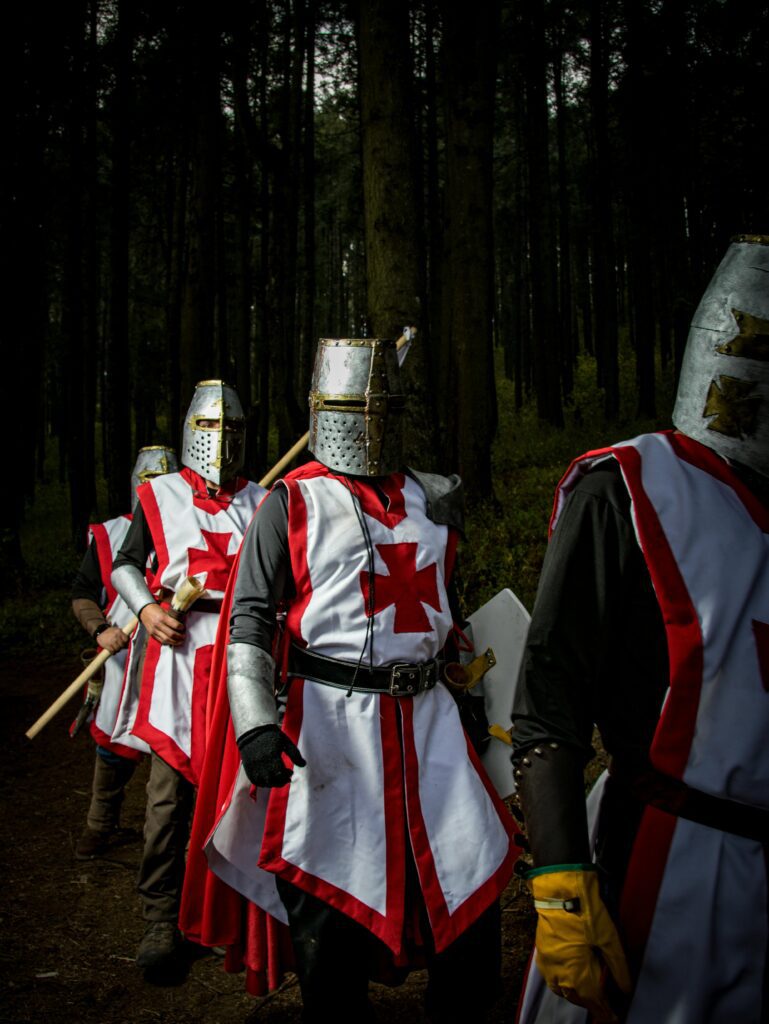
The term “Holy war” erupted in the medieval times during the Crusades (11th–13th centuries), European Christian leaders and the Church described their military campaigns as “bellum sacrum” in Latin, which literally means “holy war.”, the warrios in these deadly campaigns were often referred to as “miles Christi” (soldiers of Christ) Warriors often received special blessings, or had a priest perform a special mass, before marching into battle against those they considered the infidels.
In the Army today, the person who typically blesses Christian fighters or soldiers before going to war is often called a chaplain. A chaplain is a clergy member who provides spiritual guidance, prayers, and blessings to military personnel. In historical contexts, this could also be a priest, minister, or monk, depending on the denomination, who offers blessings or prayers for the soldiers’ safety and success in battle.
Let’s history speaks for itself: Over 200 million people killed since the Crusades.
It was not Islam or the Muslims who invented the term “Holy War” and it was not the Muslims either who were responsible for the death of 16 million in World War I, for 85 million deaths in World War II, or for the Holocaust and the killing of six million Jews. It was not Muslims who invaded 35 countries in the Americas, committing widespread ethnic cleansing and genocide of the Native Indians. The invaders spared no one from men, women, the elderly, children, or babies, taking their land and forcibly converting them to the invaders’ religion. The death toll of indigenous peoples in the Americas (North, Central, and South America) is estimated to be between 50 to 100 million murdered, and it was not the Muslims who killed millions in the 54 countries of Africa they invaded and pillaged between the 19th and 20th century.
Also it was not the Muslims who killed millions in Vietnam, the Philippines, India, Korea, Japan, Indonesia, Indochina, Laos, cambodia, and it was not Muslims who started the Boer War, the Boxer Rebellion, the War of the Roses, the Thirty Years’ War among many other examples.
It wasn’t the Muslims either who invaded Christian lands since the 11th century:
Historically, since the time of the Crusades, Christian forces have non-stop attempted to invade Muslim countries, rather than the other way around, leading to the deaths of millions of Muslims. These invasions were often justified by false excuses, such as colonizing to bring Christian civilization to the so-called “barbarians”, securing trade routes (economic interests), claiming the presence of weapons of mass destruction, citing security threats, humanitarian intervention, protecting our way of life, freeing oppressed women, regime change, promoting democracy, etc…
Yet, to these days, Muslims are always made to look like the initiators and the barbarians. How is this possible? The answer is simple, those who control the media and the narrative, control the propaganda and write their own history. After all, is it not true that the word “History” comes from two words combined: ‘His’ and ‘Story’?
Here are some of the well-known dates listed on platforms like Wikipedia:
From the first to the eighth Crusades (Several million Muslims died, the crusaders campaigns were widespread and very destructive, similar to Gaza, they would leave nothing standing, destroying everything and everyone on their path. The First Crusade: 1096–1099; The Second Crusade: 1147–1149; The Third Crusade: 1189–1192; The Fourth Crusade: 1202–1204; The Fifth Crusade: 1217–1221; The Sixth Crusade: 1228–1229; The Seventh Crusade: 1248–1254; The Eighth Crusade: (1270): over all few million Muslims were killed; The Reconquista war (711–1492): Estimated tens of thousands of Muslims died; the Ottoman – Habsburg Wars (16th–17th Century): Estimated tens of thousands of Muslims died; The French Colonial Wars in North Africa (1830–1962): Estimated 1.5 million Algerian Muslims died; Iraq War (2003–2011): Estimated 500,000 to 1 million Muslims died; Afghanistan War (2001–2021): Estimated 200,000 Muslims died; Libya (2011): Estimated 50,000 Muslims died; Syria (2010-2024): Estimated 500,000 Muslims died; Yemen War (2010s–Present): Estimated 233,000 Muslims died; Somalia (1990s–Present): Estimated 500,000 Muslims died; Pakistan (2000s–Present): Several thousand Muslims died; Egypt (1956): Estimated several thousand Muslims died during the Suez Crisis; Lebanon (1975–1990): Estimated 150,000 Muslims died; Kuwait (1990–1991): Estimated 2,000 Muslims died during the Gulf War; Indonesia (1945): Estimated hundreds of thousands of Muslims died during Dutch Colonial Rule and Independence Struggle; Tunisia (19th–20th Century): Estimated tens of thousands of Muslims died during French Colonial Rule; Balkans war in the heart of Europe (Bosnia and Kosovo, 1990s): Estimated 100,000 Muslims died in Bosnia, and 13,000 in Kosovo; Chechnya (1994–2000): Estimated 250,000 Muslims died in the Chechen Wars; Palestine (Ongoing Conflict): Estimated hundreds of thousands of Muslims died since 1948.
And the transatlantic slave trade and the residential school systems, among a few other terrible things…
I will wrap up this history page by adding this: Also, it was not Muslims who forcibly took 12.5 million Black Africans from their countries during the transatlantic slave trade—especially since Islam advocated the freeing of slaves over 1,400 years ago and promoted equality among all human beings. Likewise, Islam and Muslims were not responsible for the abuse and abduction of half a million Indigenous children into the residential school systems in North America, New Zealand, Australia, and South Africa. Nor did Islam order the burning alive of more than 60,000 women during the 300 years of Church rule, when Pope Innocent VIII issued the papal bull Summis Desiderantes Affectibus in 1484, accusing women of witchcraft or inferiority to men. In contrast, Islam granted women fundamental rights in the 7th century.
Holy wars, indiscriminate killings, genocide, ethnic cleansing, destruction of people’s property, starving people to death, abduction of children and slavery are not principles endorsed by Islam, they are considered Haram in Islam! Totally forbidden by Islam.
Prophet Muhammad (pbuh) was very clear, he used to repeat very firmly before entering battles: Do not kill non-combatants, do not harm or kill women, children, the aged, or infirm people. Do not destroy people’s homes, fields, or livestock.
If both Prophets Muhammad and Jesus (peace be upon them) were alive today, Muhammad (pbuh) would not only have rejected ISIS, but he would have combated them. Likewise, if Jesus (pbuh) were alive today, he would not have endorsed the standing ovation in Congress for a war criminal, nor would he have supported the atrocities and countless massacres committed in his name since the Crusades. Peace and blessings be upon them both.
If there is one thing you should take with you from this long historical page, is that: In Islam, there is no “holy war,” and killing is not considered holy by any means.
And remember that since the time of the Crusaders, more than 200 million people all over the world have been killed, and it was not the Muslims who killed them!